

When IT teams look at automation tools, the choices can feel overwhelming. Puppet, Chef, Terraform, and Ansible each have passionate communities and proven track records.
The real question isn’t “which one is best overall?” but rather: “which tool fits our business needs, skill sets, and workflows?”

In many cases, organisations are choosing Ansible as their primary automation platform. But it’s not a silver bullet.
With Red Hat Ansible training, your team can learn to master automation skills and increase operational efficiency using the tool.
So, let’s look at the real-world pros, cons, comparisons, and skilling options.
The Case for Ansible
What are some benefits of using Ansible software? For one, it is beginner-friendly.
1. Low Barrier to Entry
Ansible uses YAML playbooks, which are easy to read and write. Even for those without deep programming backgrounds. This makes it approachable for system administrators, operations staff, and even cross-functional teams who need to understand automation at a glance.
Through lab-intensive, instructor-led Ansible training run by Red Hat in partnership with Lumify Work, you can go further and maximise the return on your technology investment.
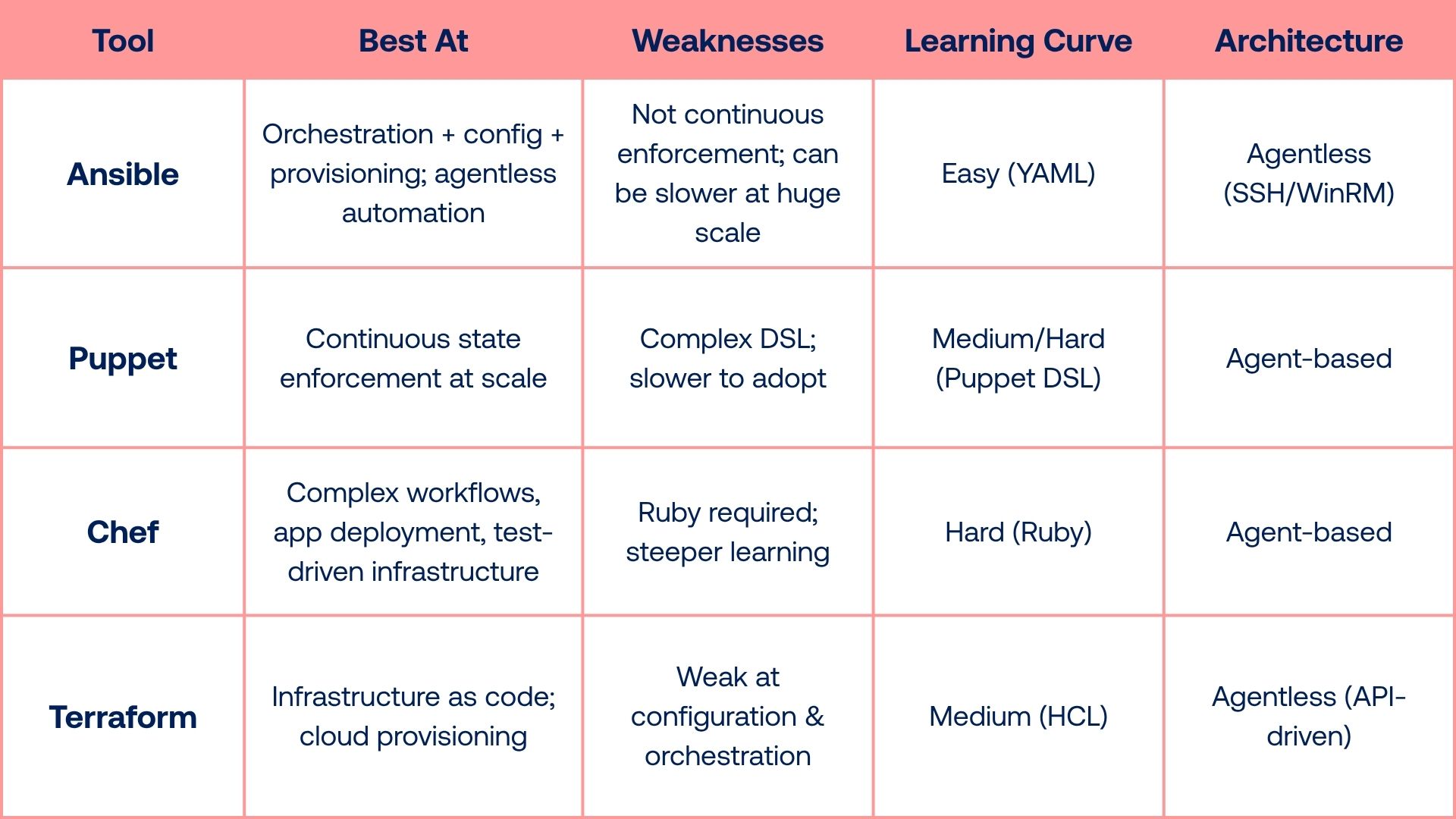
By contrast, Puppet and Chef require knowledge of DSLs (domain-specific languages)—Puppet uses its own language, while Chef is Ruby-based. Terraform uses HCL (HashiCorp Configuration Language), which is simpler than Ruby but still more specialised than YAML.
2. Agentless Architecture
The Ansible automation platform runs over SSH (or WinRM for Windows). No agents to install, manage, or update. This can significantly simplify operations, especially in heterogeneous environments or when managing servers you don’t fully control (cloud instances, third-party VMs, etc.).
Puppet and Chef rely on agents, which provide strong state enforcement but introduce lifecycle management overhead.
3. Unified Approach (Configuration + Orchestration)
Ansible is flexible enough to handle:
Configuration management (users, packages, services)
Orchestration (rolling updates, multi-tier app deployments)
Provisioning (via cloud modules for AWS, Azure, GCP, VMware, etc.)
Application deployment and automation
Terraform is excellent at provisioning infrastructure (“infrastructure as code”), but weaker on day-2 operations like patching or app deployment. Puppet and Chef are strong in configuration management but less natural at orchestration workflows.
4. Community + Enterprise Options
Free tier: Upstream Ansible (community edition) is free and open source, ideal for smaller teams or specific automation needs.
Enterprise tier: Red Hat Ansible Automation Platform (AAP) provides commercial support, analytics, role-based access control, integrations, and enterprise-scale capabilities.
This gives companies flexibility. They can start free, then scale into a supported product when governance or enterprise features are needed.
Limitations of Ansible (Where It’s Not the Best Fit)
Despite the advantages of choosing the Ansible automation platform, it may not be suited for all organisations. These scenarios are where you might consider alternatives like Puppet or Terraform.
Not as strong at “enforcing state”: Puppet excels at ensuring systems remain in the desired state continuously. Ansible, unless paired with scheduled runs or automation controllers, applies changes when you run it, but doesn’t enforce state in the same way.
Performance at a very large scale: Running Ansible across thousands of nodes can be slower compared to agent-based systems, because every run must connect over SSH. AAP mitigates this with automation controllers, but it’s still a consideration.
Complex logic/programming tasks: Because playbooks are YAML, they’re not as suited for complex logic as a full programming language like Ruby (Chef).
See these real-world comparisons:
Why Companies Lean Toward Ansible
Red Hat Ansible is widely recognised as a leading automation tool in IT environments. According to Theirstack, it is deployed by 81,000+ companies across 129 countries. Why?
Ease of adoption: Admins can write their first playbook in hours.
Breadth: Covers provisioning, config, orchestration, and app deployment in one tool.
Flexibility: Free to start, with an enterprise-grade platform (AAP) when scaling.
Agentless simplicity: No extra daemons or processes to manage.
That said, some companies even use Ansible alongside Terraform: Terraform to provision infrastructure, Ansible to configure and orchestrate applications on top.
Final Thoughts on Comparisons and Ansible Red Hat Training
Choosing an automation tool isn’t about “picking the winner” in a hype race. It’s about matching the tool to your team’s needs and workflows.
If you want a continuous, enforced state at scale, Puppet might be the right fit.
If you need complex, programmatic infrastructure automation, Chef could be a valuable tool.
If your primary focus is cloud provisioning, Terraform excels.
But if you want a simple, agentless, multi-purpose automation tool with a clear path from free usage to enterprise support, Ansible makes a compelling choice.
Whether you start with free Ansible or adopt Ansible Automation Platform (AAP) for enterprise scale, the key benefit is this: your team can move quickly, automate consistently, and bridge the gap between infrastructure and application operations.
Learn more about the pros, cons, and features of Ansible through Red Hat training. Read here for a comparison of Red Hat Courses like RHCSA vs RHCE.
Lumify Work is proud to offer clients access to official Red Hat training courses through our partnership with Red Hat. Learn in person at one of our campuses or at your site.