

Artificial Intelligence (AI) is transforming industries at an unprecedented pace, creating opportunities for innovation, efficiency, and growth.

However, with great power comes great responsibility. As AI systems become more integrated into business and Philippine society, the need for ethical AI practices and skilled professionals has never been more critical.
How can your organization adhere to guidelines on the responsible use of AI? The answer is in equipping your teams with the right skills and knowledge through AI courses.
The Imperative for AI Ethics
The Analytics and AI Association of the Philippines (AAP) Code of Ethics emphasizes that AI professionals must uphold principles of transparency, fairness, accountability, and privacy.
These guidelines align with ASEAN’s AI governance standards and aim to ensure that AI contributes positively to society while minimizing risks.
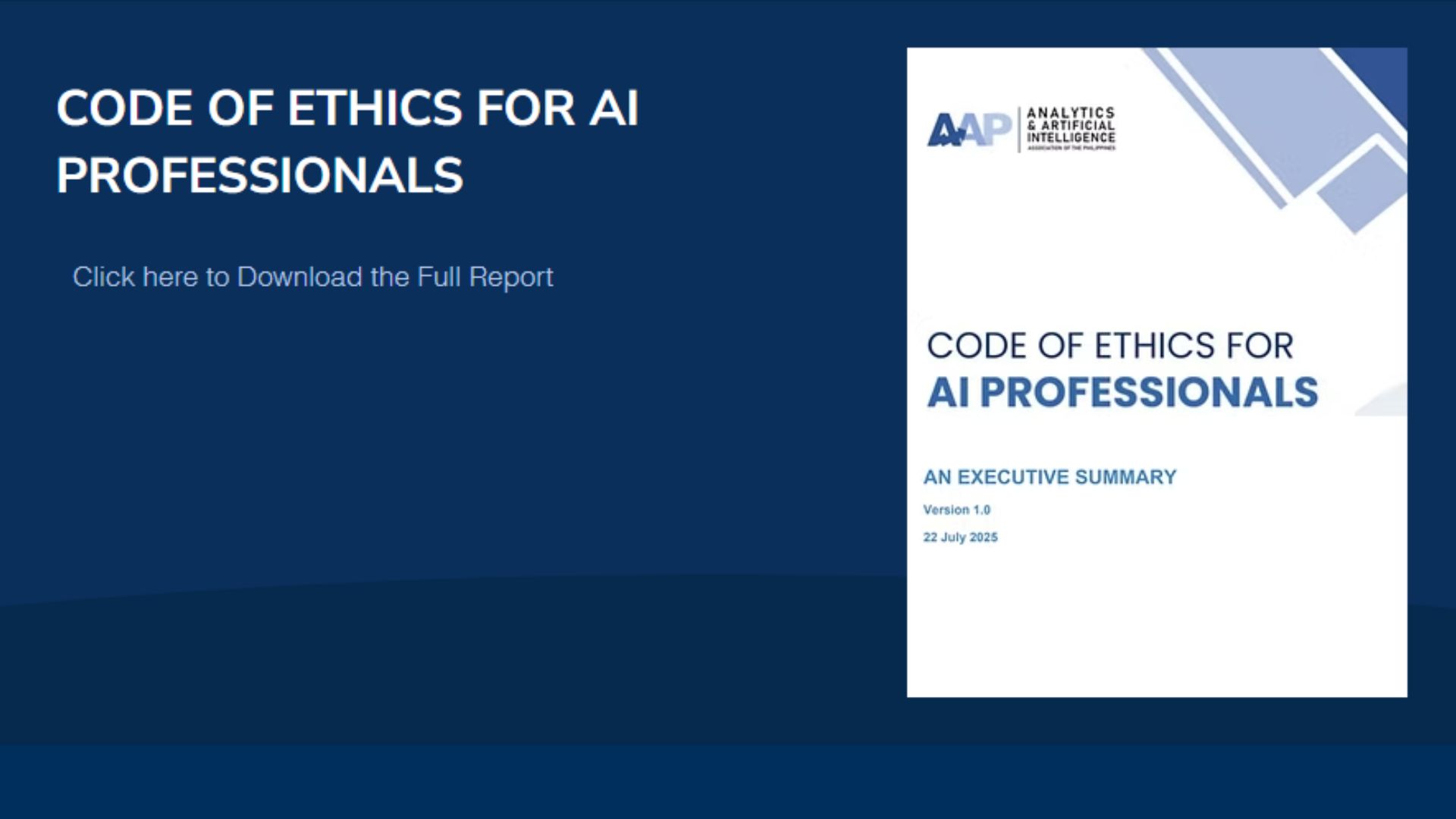
Key principles outlined in the AI code of ethics include:
Promoting societal well-being and environmental sustainability.
Preventing harm through safe practices.
Ensuring fairness and mitigating bias in AI systems.
Respecting privacy and confidentiality in data handling.
Maintaining professional competence and integrity.
These principles are not just theoretical; they are essential for building trust in AI technologies and safeguarding public interest.
The AI Skills Gap Challenge
Despite the growing demand for AI solutions, many organizations struggle to find talent with both technical expertise and ethical awareness.
57% of organizations cite a lack of AI skills and knowledge as their top barrier to adoption in a 2025 Philippine AI Ecosystem report.
The BPO/IT-BPM sector faces a critical shortage of AI-equipped talent. This despite over 60% of firms adopting AI. This impedes the creation of up to 800,000 potential new jobs over five years.
This gap poses risks, including poorly designed systems, data breaches, and unintended bias. To address this, businesses must invest in AI-skilling programs that combine technical training with ethical frameworks.
Partnering with Reputable AI Training Providers
One effective way to bridge this gap is to partner with trusted training providers like Lumify Work Philippines (also known as DDLS Aboitiz Inc.). Lumify Work offers industry-recognized programs in AI, cloud computing, and cybersecurity.
These programs equip professionals with cutting-edge technical skills and emphasize responsible AI practices aligned with global standards.
For organizations that leverage cloud platforms, skilling ensures proper access and compliance. Teams can learn to follow structured onboarding steps on Microsoft Azure and AWS. These steps include validation and partner access setup. Doing so helps maintain security and accountability in enterprise environments.
Examples of AWS AI courses include Exam Prep: AWS Certified AI Practitioner (AIF-C01), Agentic AI on AWS Foundations, and Machine Learning Engineering on AWS.
For Microsoft, you can consider Essentials courses for leaders and change managers, such as Microsoft AB-730T00 - Transform Business Workflows with Generative AI and Microsoft AB-731T00 - Drive AI Transformation in your Organization.
Look for AI training providers that maintain partnerships with reputable industry associations and certification programs.
ISACA is one such industry association. You can earn AI security credentials, such as Advanced in AI Audit (AAIA™), Advanced in AI Risk (AAIR™) and Advanced in AI Security Management (AAISM™).
AICERTs offers industry-recognized AI certification programs through Lumify Work Philippines. Their AI online courses are role-based for functions such as Developer, Customer Service, Designer, Educator, Finance, Government, Healthcare Professional, and more.
Why Invest in AI Courses Now?
The appetite for taking AI courses continues to grow. A study by The Economist Impact and Google found that 42% of Filipino employees want to acquire new digital skills, such as AI and Machine Learning (ML).
Across industries, the potential for AI to support growth is undeniable. A joint study by Google Philippines and Public First found that AI could boost the country's economy by P1.8 billion and increase average worker productivity by P110,000 per year. Additionally, the 2025 Economic Opportunity Report forecasts productivity gains in the retail, finance, and public services sectors.
So, the main question becomes: How do you ensure the responsible adoption of AI? The way forward is to develop the skills to understand regulations and AI codes of ethics. AI skilling helps:
Future-proof your workforce: AI is no longer optional; it’s a core driver of competitiveness.
Mitigate ethical and legal risks: Skilled professionals can design systems that comply with regulations and uphold societal values.
Accelerate innovation responsibly: Ethical AI fosters trust among customers and stakeholders, enabling sustainable growth.
If your organization is ready to embrace AI responsibly, start by investing in ethical AI training and technical upskilling. Explore programs from reputable providers like Lumify Work Philippines and ensure your teams are equipped to lead in an AI-driven future.
Check out our portfolio of AI and Machine Learning courses. Contact our team to discuss your requirements. Or download our AI and ML brochure to get more information.